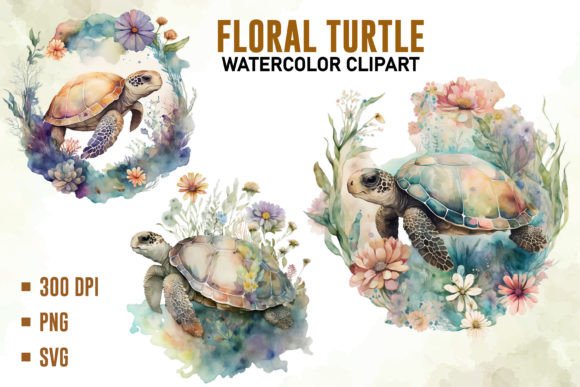
Floral Turtle Watercolor Clipart
A Designer’s First Look: Soft, Whimsical—But Will It Stitch Cleanly?
When I opened the Floral Turtle Watercolor Clipart bundle, my first thought wasn’t “cute”—it was “delicate.” The illustration balances botanical softness with gentle turtle anatomy: loose watercolor blooms curling around a rounded shell, petals bleeding softly at the edges, no hard outlines. It feels like something you’d find in a handmade baby journal or a boutique tea towel—not a bold logo or high-contrast logo mark. That’s not a flaw. It’s a signal. This isn’t a design built for dense fill stitch on a baseball cap. It’s built for breathing room, subtle charm, and intentional slowness.
Real Project Test: Embroidering a Linen Tote Bag for a Local Nursery Shop
I pulled this design into my embroidery workflow to test it on a 12×14” natural linen tote—exactly the kind of product a small shop owner might stock for baby showers or spring markets. The Floral Turtle Watercolor Clipart sat beautifully near the bottom corner, scaled to 3.8”. But here’s what mattered most: how the watercolor illusion translated into thread. Since there’s no actual vector outline defining every petal edge, I had to interpret the PNGs carefully when digitizing. I opted for a mix of satin stitch for the turtle’s shell (to hold shape), low-density fill for the florals, and strategic running stitch accents along softer petal tips. The result? A finished product that looked hand-painted—not machine-made. Customers paused longer. They touched the stitching. That’s the quiet power of this design: it invites closeness.
Where It Shines—and Where It Needs Guardrails
The Floral Turtle Watercolor Clipart excels in contexts where texture, tenderness, and tactile warmth matter:
- Personalized baby items: Swaddles, burp cloths, and onesies—especially on light cotton or bamboo blends—let the floral softness read clearly without overwhelming tiny proportions.
- Boutique kitchen textiles: Tea towels, aprons, and pillow covers benefit from its organic flow. It reads as artisanal, not mass-produced.
- Holiday or milestone gifting: Think Easter baskets, first-birthday keepsakes, or “welcome to the garden” nursery decor. Its theme is gentle, inclusive, and seasonally flexible.
- Digital product previews: As Illustrations, these files work beautifully in printable mockups for Etsy sellers—no need to over-digitize; the watercolor aesthetic sells itself in flat visuals.
But let’s be direct: this isn’t a go-to for every project. Avoid using Floral Turtle Watercolor Clipart on:
- Stretchy fabrics like knits or performance tees—without heavy stabilizer, those soft edges can blur or distort.
- Dark or heavily textured backgrounds (e.g., corduroy, thick terry cloth)—the subtle gradients vanish without strong contrast.
- Small hoop sizes under 4×4”—fine details like individual stamen or thin vine tendrils risk becoming indistinct or lost in stitch density.
- Curved surfaces like structured caps—watercolor-style gradients don’t wrap cleanly without significant manual redrawing.
What This Design Says About Your Brand—Without a Word
Using Floral Turtle Watercolor Clipart tells your customer something immediate: you value nuance over noise. It supports brand consistency for makers who lean into slow craft, eco-conscious materials, or nature-rooted storytelling. On an embroidered patch for a sustainable clothing line? It signals intention. On a custom sweatshirt for a children’s yoga studio? It reinforces calm and grounded energy. But it also raises expectations—you’re promising softness, care, and visual harmony. If your stitching looks rushed or your thread choices clash (say, neon green on pale mint), the mismatch is louder than with bolder graphics.
Practical Notes Every Embroidery Designer Should Check Before Digitizing
This isn’t a plug-and-play embroidery file. It’s a Graphics bundle—SVG and PNG only—so digitizing is required. Before committing to a client project or batch production:
- Test on scrap fabric first, especially if using lightweight or loosely woven material—check how the watercolor bleed translates in thread.
- Review stitch density manually. Auto-digitizing often overfills delicate florals. Aim for 30–45% fill density in petal areas to preserve translucency.
- Confirm hoop size compatibility. The largest version of the Floral Turtle Watercolor Clipart fits comfortably in a 5×7”, but scaling down below 3” risks losing definition in the turtle’s eye or vine tips.
- Inspect small details in black-and-white mockups. What reads as soft gray in color may disappear entirely on dark fabric—adjust thread contrast accordingly.
- Use cutaway stabilizer on knits, tear-away on stable wovens, and consider topping for extra smoothness on textured linens.
- Verify licensing before selling finished products. Since this is labeled a Watercolor Turtle Sublimation Bundle, confirm whether commercial embroidery rights are included—or if resale requires additional permission.
Final Thought: Not Just a Clipart Bundle—A Mood You Can Stitch
The Floral Turtle Watercolor Clipart won’t dominate a tradeshow booth. It won’t shout from a social media feed. But in the right context—a hand-stitched linen pouch, a limited-run baby blanket, a thoughtful gift tag—it lingers. It earns trust because it doesn’t try too hard. For Etsy sellers building a cohesive, values-driven shop, for craft fair vendors curating tactile experiences, for apparel decorators seeking quiet distinction—it’s a quietly powerful asset. Just remember: its strength lies in restraint. Let the watercolor breathe. Let the turtle rest. And let your stitching honor the softness already built into the design.